
Why a Strong Digital Marketing Strategy Is Essential for Senior Care Operators
Learning Journal Article 007They’re Already Looking for You
Right now, someone’s daughter is sitting at her kitchen table after the kids are in bed, searching Google for help with her aging father. She’s not sure what she’s looking for yet. She just knows something has to change.
She’s one of 6,000 people searching for senior care services every single hour (1). She’s part of a growing wave of adult children — professional, overwhelmed, researching online before they ever pick up the phone — who will make most of the care decisions for the next generation of aging Americans.
The demand for what senior care operators provide has never been higher. The challenge isn’t attracting families — it’s being findable when they go looking. And most senior care businesses, through no fault of their own, are nearly invisible online to the very families they could serve best.
This article is about changing that. Not with a massive marketing budget or a full-time social media manager — but with a clear understanding of where families search, what they’re looking for, and a few high-impact actions any operator can take regardless of business size or stage.
The Numbers That Should Change How You Think About Marketing
Before getting into tactics, it’s worth understanding the scale of what’s happening online in the senior care space because most operators significantly underestimate it.
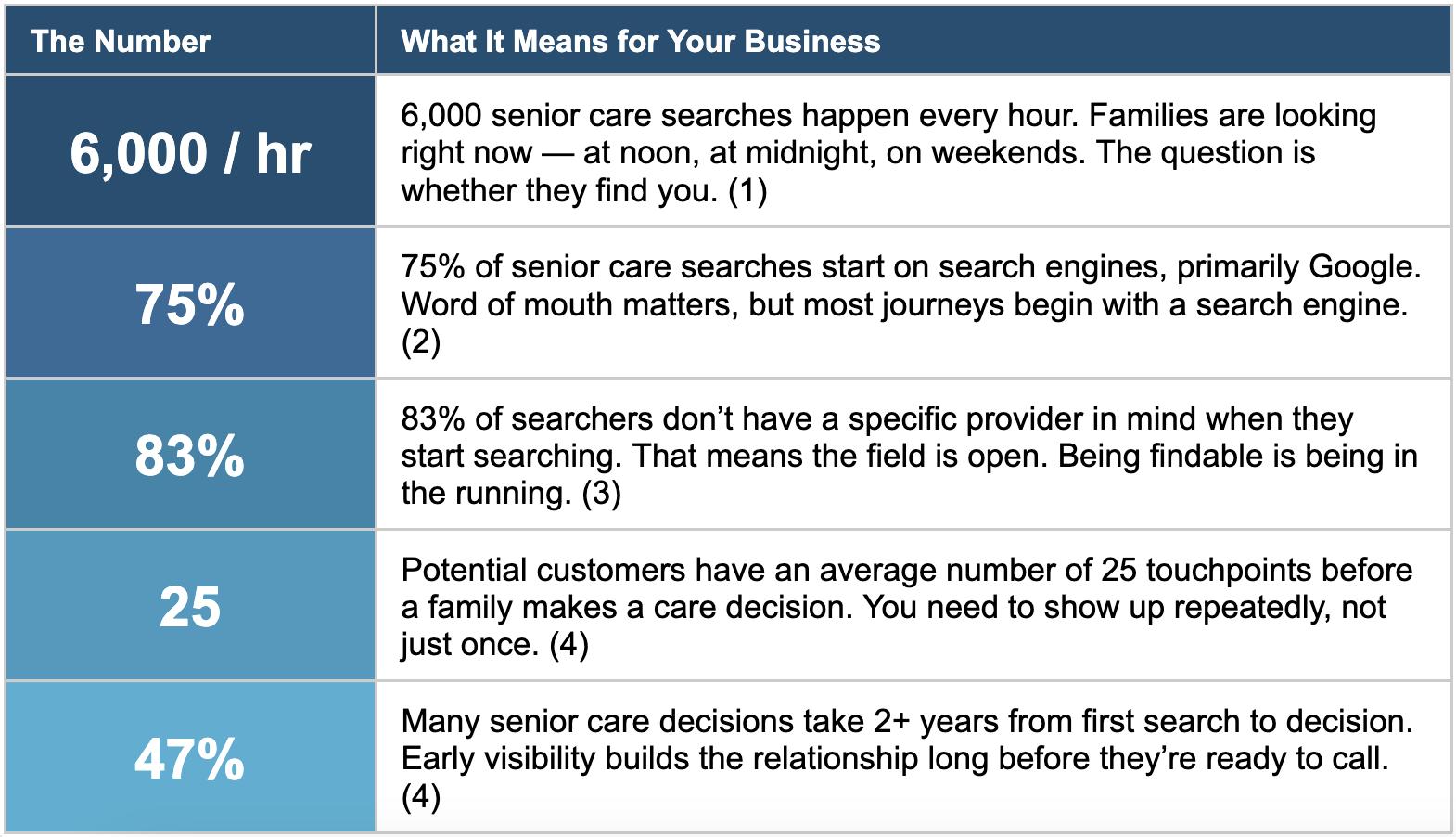
The picture these numbers paint:
Families start searching long before they’re in crisis
They search repeatedly over months or years
They start without a provider in mind
They almost always begin on Google.
Being absent from that process doesn’t mean they don’t find a provider. It means they find someone else.
Who Is Actually Doing the Searching
Understanding search behavior in senior care requires understanding who is actually at the keyboard. It’s rarely the person who will receive the care.
The Adult Child Decision-Maker
The typical person searching for senior care services is a daughter, 45–64, juggling a career, her own family, and increasing responsibility for an aging parent. She’s not necessarily in crisis yet, but something has shifted. A fall. A concerning phone call. A visit home that didn’t feel right.
She searches at odd hours: late nights, lunch breaks, weekends
She reads reviews carefully and compares multiple options before calling anyone
She’s feeling guilty, overwhelmed, and desperate for someone she can trust
Adults 50–64 use the internet at rates nearly identical to younger generations — 98% regularly, compared to 90% of seniors 65 and older (5). But this age group actively searches for information, reads reviews, and makes decisions online in ways their parents' generation doesn’t. Your marketing needs to meet them there.
The Two Search Moments That Matter Most
Adult children typically search in two distinct modes, and most senior care businesses only show up for one of them.
The Early Search: “How do I know if my parent needs help?”
This happens before families know what service they need. They’re looking for information, reassurance, and orientation. They’re not ready to call yet — but they’re forming opinions about who seems trustworthy and knowledgeable. Operators who show up here build a relationship months before the family is ready to act.
The Ready-to-Buy Search: “Adult day care near [city]”
This happens when urgency has arrived. The family knows what they need and they’re comparing options quickly. Being on page one of Google for these searches is table stakes for capturing this moment. If you’re not there, you don’t exist to this family.
Quick Exercise: Can They Find You?If you’re a senior care operator, try both searches right now. First: search your service + your city or county. Are you on page one? Who has paid ads? Second: search “How do I know if my parent needs help with [relevant service]?” Who is educating adult children in that early research phase? Could it be you?
What Families Actually Look For When They Find You
Getting found is step one. Converting that visit into a phone call requires something different — trust signals that tell a worried adult child this is a place she can rely on for her parent.
The 30-Second Homepage Test
When a family lands on your website, they make a subconscious decision about whether to stay or leave within seconds. Your homepage needs to answer three questions without them having to look for the answers:
Can you help my parent’s specific situation?
Can I trust you with my parent’s safety?
How do I take the next step right now?
Most senior care websites answer the first question adequately and struggle badly with the second and third. Trust-building requires showing faces — real staff, real families, real outcomes. And the path to contact needs to be obvious: a phone number in the header, a clear call to action, an after-hours contact option for the 11 PM searcher.
What Makes Adult Children Say Yes
Reviews from other adult children, not just general star ratings
Staff photos with names — faces make a business feel real and accountable
Response within 2 hours to inquiries — slow response signals disorganization to a worried family
Visible credentials and licensing — removes uncertainty about legitimacy
Family testimonials that speak to peace of mind, not just service features
After-hours contact options — because the most urgent searches happen outside business hours
Where to Start: A Practical Roadmap by Business Stage
One of the reasons senior care operators avoid digital marketing is that it feels overwhelming — like there’s an infinite list of things to do and no clear starting point. The reality is that a few high-impact actions, done consistently, move the needle more than trying to do everything at once.
Here’s a practical starting point organized by where you are today:
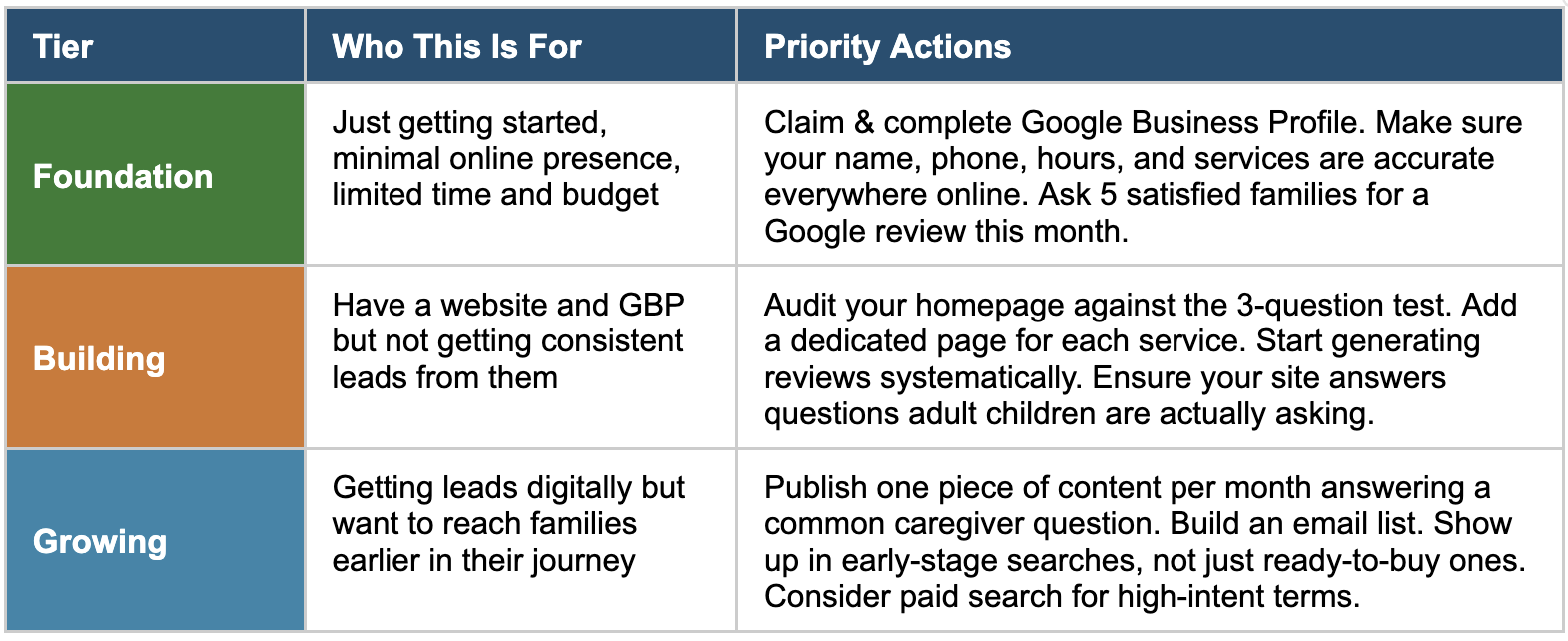
The One Thing Every Business Can Do This Week
Regardless of tier, the single highest-leverage action for any senior care operator with limited time is this: claim, complete, and actively manage your Google Business Profile.
Your Google Business Profile is what appears when someone searches your business name or your service type in your area. It controls your appearance in Google Maps, local search results, and the knowledge panel on the right side of search results. It’s free, it’s relatively simple to set up, and most operators have either not claimed it or left it partially complete.
Verify your name, address, phone number, and hours are accurate
Add photos: your facility or office, your team, your services in action
Write a description that speaks to adult children, not seniors
Select the right service categories so Google shows you for relevant searches
Start asking satisfied families to leave a review — and respond to every review you receive
The Longer Game: Showing Up Before the Crisis
The statistics - about 25 touchpoints and 47% of families taking 2+ years to decide - point to something important: most of the senior care marketing journey happens before a family is ready to buy. Operators who only focus on ready-to-buy searches are competing for a fraction of the available opportunity.
The longer game is becoming the trusted resource families find early, return to repeatedly, and think of first when urgency arrives. This doesn’t require a sophisticated content operation — it requires showing up consistently with genuinely useful information.
What “Showing Up Early” Looks Like in Practice
One blog post or article per month answering a question adult children actually ask — “what’s the difference between a board and care home and assisted living?”, “when does someone need a DME evaluation?”, “how do I talk to my parent about needing more help?”
A simple email list that lets you stay in touch with families who found you but aren’t ready yet
Google Business Profile posts that keep your listing active and signal to Google that your business is current
Participation in local caregiver Facebook groups and online communities as a helpful resource, not a sales pitch
None of this requires a marketing team. It requires consistency and making visible online how you’re useful offline to the families you serve.
Closing
The families who need what you offer are searching for you right now. They’re on Google at midnight, reading reviews on their lunch break, comparing options during a commute. They’re overwhelmed and looking for someone they can trust.
Digital marketing in senior care isn’t about going viral or running expensive ad campaigns. It’s about making sure that when a family goes looking for exactly what you provide, they can actually find you — and when they find you, they see something that makes them feel like they’re in good hands.
The businesses that will thrive in the coming decade of elder care growth aren’t necessarily the biggest or the best-funded. They’re the ones that understood early that their families were already looking — and made it easy to be found.
Sources
Senior Housing News. (2017, October 3). Google's Message to Senior Living: Mobile-First Marketing is a Must. Senior Housing News. https://seniorhousingnews.com/2017/10/03/googles-message-senior-living-mobile-first-marketing-must/
Senior Housing News. (2015, March 31). Google Data Sheds New Light on Senior Living Search Trends. Senior Housing News. https://seniorhousingnews.com/2015/03/31/google-data-sheds-new-light-on-senior-living-search-trends/
Invoca. (n.d.). Senior Living Marketing Stats. Invoca. https://www.invoca.com/uk/blog/senior-living-marketing-stats
Creating Results. (2024, September 17). What Are Good Senior Living Sales Benchmarks & KPIs to Know? Creating Results. https://creatingresults.com/blog/2024/09/17/what-are-good-senior-living-sales-benchmarks-kpis-to-know/
Pew Research Center. (2024). Internet/Broadband Fact Sheet. Pew Research Center. https://www.pewresearch.org/internet/fact-sheet/internet-broadband/